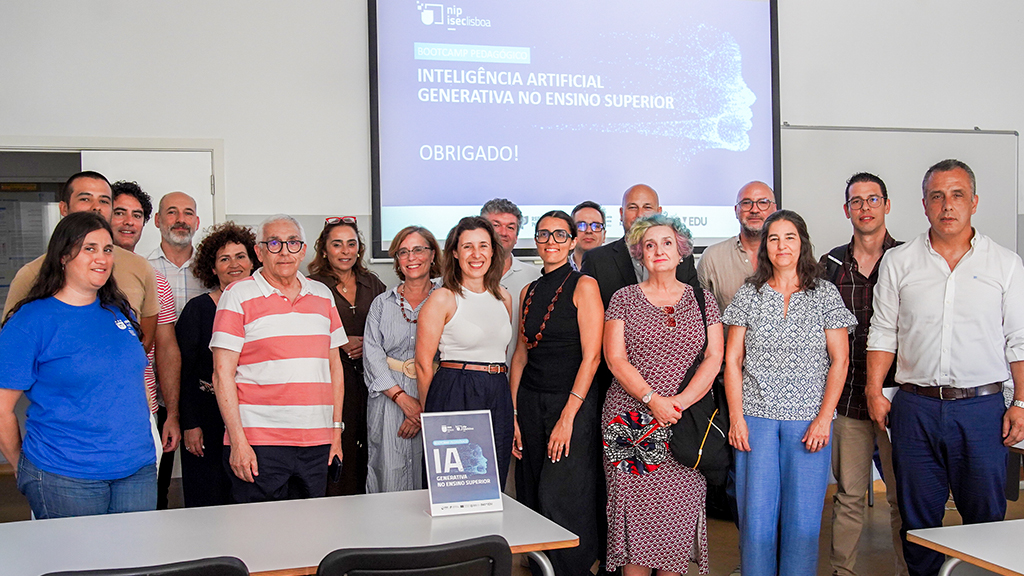
“Generative Artificial Intelligence in Higher Education” was the central theme of the Pedagogical Bootcamp dedicated to Generative Artificial Intelligence (AI), held at ISEC Lisboa on 29 June under the scope of the INOVEDU Project. The initiative aimed to encourage reflection, experimentation, and the sharing of pedagogical practices concerning the challenges that AI presents for teaching, learning, and assessment.
The opening session was delivered by Marina Reis, Director of Teaching and Learning at ISEC Lisboa, and Nuno Ricardo Oliveira, Coordinator of the Pedagogical Innovation Unit at ISEC Lisboa. They addressed the relevance of this topic, particularly within the higher education context, emphasizing the importance of adopting these technologies in a critical and ethical manner.
The keynote lecture was delivered by Rodrigo Tavares, lecturer at the Nova School of Business and Economics, who presented the topic “Generative Artificial Intelligence and the Transformation of Higher Education.” His presentation provided an opportunity to reflect on the impact of generative AI on higher education institutions, particularly regarding teaching practices, student learning processes, and the need to rethink pedagogical models in response to a rapidly evolving technological landscape. The presentation also introduced eleven trends expected to shape the future of AI-enhanced education.
Throughout the day, approximately fifty participants had the opportunity to explore different dimensions of AI integration within academic contexts through three thematic workshops addressing strategies, stages, and implementation methods.
Workshop 1, entitled “Teaching with AI: Pedagogical Strategies for Active Learning,” facilitated by Celestino Magalhães, lecturer at the Jean Piaget School of Sports and Education, explored AI-supported lesson planning strategies, the development of teaching materials, the design of pedagogical prompts, and practical application examples across different scientific disciplines.
Workshop 2, entitled “AI Tools for Higher Education Faculty,” led by Carla Martinho, lecturer at ISCAL of the Polytechnic Institute of Lisbon, focused on the practical use of tools such as ChatGPT, Copilot, Claude, Gamma, and other digital solutions. Topics included content creation, automation of teaching-related tasks, and hands-on demonstrations designed for everyday academic practice.
The afternoon concluded with Workshop 3, “Assessing with AI: Rethinking Assessment in the Age of Artificial Intelligence,” facilitated by Nuno Ricardo Oliveira, lecturer at ISEC Lisboa. This session enabled participants to reflect on the impact of generative AI on the assessment of written assignments, identify the limitations of traditional assessment models, and explore more authentic assessment strategies focused on learning outcomes and aligned with the responsible use of artificial intelligence. This Pedagogical Bootcamp provided an opportunity to discuss and strengthen pedagogical practices related to the use of AI in the classroom, while also supporting faculty development and capacity building.
The promotion of initiatives such as this reinforces the commitment of Private Higher Education Institutions to pedagogical innovation, faculty development, and the advancement of educational practices aligned with contemporary challenges, contributing to a more innovative and technology-driven higher education environment.