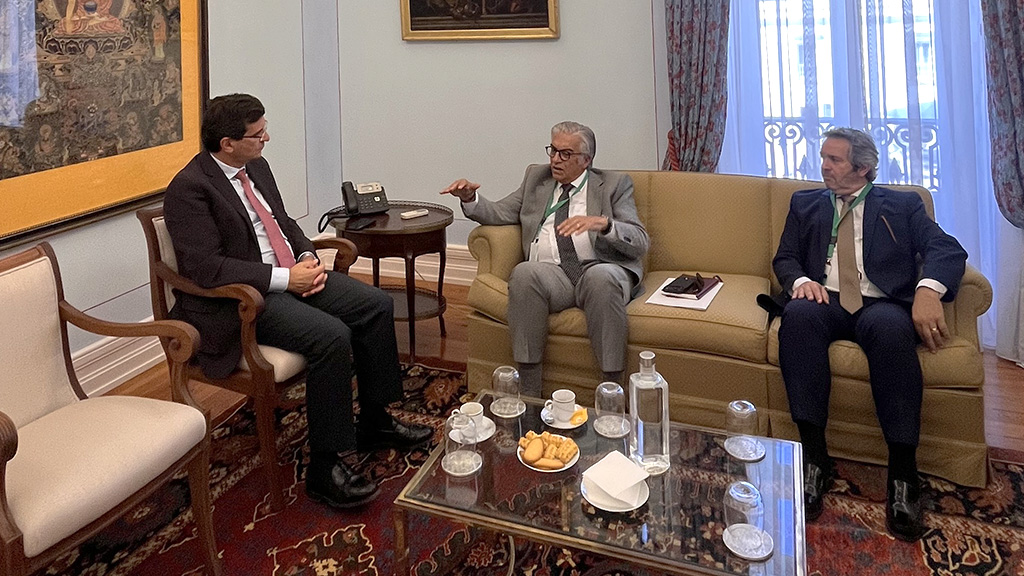
To the Honourable Chief of Staff of the Secretary of State for Science, Technology and Higher Education, Dr. Pedro Barrias,
Subject: APESP Comments on the Draft Guiding Order for setting vacancies for special access competitions for the 2022-2023 academic year
Following the pronouncement promoted by Your Excellency regarding the draft guiding order for setting vacancies for special access competitions for the 2022-2023 academic year, the following considerations are presented.
The draft Order in question essentially adheres to the framework of principles and rules that have guided the setting of vacancies for special access competitions to higher education, under the terms of the decrees in force in previous years.
The terms and criteria upon which the legislator supports and establishes the vacancies should be rethought and reformulated in consultation with the heads of Higher Education Institutions, from both sectors. These criteria appear increasingly out of step with the needs of those seeking higher education, namely the students themselves, considering that the nature and training context are increasingly diverse and differentiated.
Safeguarding the considerations expressed above, the solutions proposed in the draft in question approach, in some way, issues enunciated by APESP in previous years, also considering the arguments it has always presented. These arguments are based on the perspective of providing the opportunity to obtain higher education to those who seek it and, on the other hand, ensuring the optimization of the resources installed and made available by Private Higher Education Institutions, contributing to the development of the transmission of knowledge and higher education.
In these terms, and considering this the appropriate moment, it is once again necessary to emphasize that the legislator must prevent and safeguard the competence and responsibility of Higher Education Institutions for managing the filling of the vacancies they make available, in accordance with the resources available.
Thus:
- The criterion for setting maximum limits of 20% of the vacancies fixed for the various special access and admission competitions, with reference to the number of vacancies to be fixed for the general access regime, in accordance with the maximum limits defined by accreditation, is questioned immediately.
- The provision established in the body of article 4, where it is established that “(…) the total number of vacancies for each institution/study cycle pair for the special competitions for holders of secondary level dual certification courses and specialized artistic courses has a maximum limit of 15% of the number of vacancies fixed for the same institution/study cycle pair for the general access regime,” is reiterated as positive, since this number will not be counted in the “vacancies fixed under this article” in the context of the limits established in article 3.
- An analogous criterion is established regarding the setting of vacancies allocated to candidates for higher education through the special competition for those Over 23 years old. This number, although it cannot be less than 5% nor more than 20% of the number of vacancies fixed for the general access regime, its non-accounting for the purposes of what is established there is expressly foreseen (cf. article 3), as stated in article 5 of the draft. However, it follows from article 3 of Decree-Law No. 113/2014, of 16.07, by reference from article 3 of the draft order in question, the impossibility of utilizing remaining vacancies from the general access regime (cf. articles 5 and 7, nº 2 of the draft) for the special access competition for those over 23 years old, a solution for which no basis or justification can be found.
- In line with what APESP has referenced in previous years, the doubt raised during APESP’s position on the draft decree (which led to Decree-Law No. 11/2020, of 02.04) regarding the special competitions for candidates with secondary level dual certification and specialized artistic courses, and which concerns the provisions of paragraphs 4 and 5 of article 4, is reiterated: – the basis for imposing the fixing of vacancies for all study cycles in the same area of education and training is not understood.
- The criterion now defined in the first part of paragraph 2 of the same article 9 of the draft is welcomed with satisfaction, the determination of which is considered innovative and very positive, and which states that “vacancies fixed under the terms of this order, which are not filled, may be transferred to other special competitions or to the general access regime (…),” an issue that has long been referenced by APESP.
However, although it is certain that the Institutions hold the knowledge of their own material and human resources (namely, the teaching staff and facilities made available), the legislator’s understanding in determining that those unoccupied vacancies can only be filled as provided for in the second part of the same paragraph 2 of the aforementioned article 9, i.e., “(…) within the limits to be defined by order of the member of the Government responsible for the area of science, technology and higher education,” must be challenged.
In conclusion, it should be referenced and suggested to reflect on the grounds that lead to the prevention of the transmissibility of unoccupied vacancies within the context and terms established in paragraph c) of paragraph 1 of article 9.
APESP, June 24, 2022